The music style has changed a lot throughout the history of the band; it was originally rock, and had a lot of metaphors and social messages to portray their opinions on various topics, such as marriage, drug abuse and school. Their first music video was I
Write Sins Not Tragedies, which is a narrative and performance. It shows a wedding in which the bride runs off and cheats on the groom. Like a lot of their other early songs, the lyrics had a very negative feel, despite the upbeat music video.
From their second album Pretty. Odd., this was the first music video. This was very different from trheir first album, as the song is very upbeat and matches the concept of the video, which is a parade, and the bands in seperate fantasy worlds. The sound has also changed a lot since the first album as the genre is much more similar to pop punk and steampunk, rather than alternative rock. It is similar to I Write Sins Not Tragedies in that it is a narrative and performance video. The bands image changed a lot in this video, and portrays them as more relaxed with their fame.
Ready to Go (Get Me Out of My Mind) was from P!ATD's 2011 album Vices & Virtues, shortly after the end of their hiatus. The video starts as performance, with another image change; the members could be described as hipster. The video begins to have an element of narrative, as he jumps into the 1960s, however, the performance element continues. The Male Gaze is used in the video, as the two female backing dancers are dressed fairly provactively. The bands jumps into the 1800s and are dressed as chimney sweeps for the instrumental, which features a semi acrobatic dance routine. The band jumps into a circus type scene, where Brendon Urie gets cannonballed through the sky to end with a final dance number in the streets. Each stage featured a different outfit, which make sthe video identify more as pop than rock or punk.
This Is Gospel was released as the second single from their fourth studio album Too Weird to Live, Too Rare to Die!. This music video is a performance and narrative. The narrative shows Brendon Urie fighting to get out of a surgery while performing frantically. You then see him getting dressed by other people, and then buried. There are a few effects with water and rope, showing that Urie has no escape. In the end he gets pulled still in surgery, but escapes from the ropes. This video is full of metaphors about life and death, similar to P!ATD's first album. The genre returned to rock slightly in this song too, however, with an element of electronica. The music video was released at the same time as the album.
Nicotine was the fourth music video from Too Weird to Live, Too Rare to Die!. Nicotine was filmed in black and white, and uses a lot of editing with layering shots to create clones and faded images. The video uses a lot of of very short clips that fade into each other. The video only features Brendon Urie, in several locations; on a bridge, in a bar, in what appears to be his house and driving in his car. There are also clips that show the girl that the song is about. At the end of the song you see Urie placing flowers at a gravestone, implying that the girl died. The black and white suggests mouning, and the quick pace of the video matches the tempo of the song, however, the content and topic of the music video opposes the beat and tempo. This song has a very large element of electronica, with some rock; returning to the roots of their first album, A Fever You Can't Sweat Out.
Star Profile - Panic! At The Disco - Image
  |
| P!ATD - 2006 |
 |
| P!ATD - 2008 |
 |
| P!ATD - 2008 (live) |
 |
| P!ATD - 2011 |
 |
| P!ATD - 2013 |
 |
| P!ATD - 2014 |
Star Profile - Panic! At The Disco - Albums
 |
| A Fever You Can't Sweat Out |
 |
| Pretty. Odd. |
 |
| ...Live In Chicago |
 |
| Vices & Virtues |
 |
| Too Weird To Live, Too Rare To Die! |
Star Profile - Panic! At The Disco
Panic! At The Disco is a rock band, originally formed in 2004.
Their first album, A Fever You Can't Sweat Out, was released September 27th 2005, and was classed as Pop Punk and Alternative Rock.


In the History of Panic! At The Disco, the line up has changed several times. This graph shows each members duration of time with the band, and what instruments they played.

Nominations & Awards
MTV Video Music Awards:
Nominated: Best Direction (2008) for "Nine in the Afternoon"
Nominated: Best Pop Video (2008) for "Nine in the Afternoon"
Won: Video of the Year (2006) for "I Write Sins Not Tragedies"
Nominated: Best Group Video (2006) for "I Write Sins Not Tragedies"
Nominated: Best Rock Video (2006) for "I Write Sins Not Tragedies"
Nominated: Best New Artist in a Video (2006) for "I Write Sins Not Tragedies"
Nominated: Best Art Direction in a Video (2006) for "I Write Sins Not Tragedies"
Los Premios MTV Latinoamérica:
Nominated: Best International Rock Group (2007)
Nominated: Best International Rock Group (2008)
MTV Asia Awards 2008:
Won: edc Style Award
TMF Awards:
Won: Best Video International (2006) for "I Write Sins Not Tragedies"
Grammy Awards:
Nominated: Best Boxed or Special Limited Edition Package (2008)
Nominated: Best Boxed or Special Limited Edition Package (2009)
Kerrang! Awards 2011:
Nominated: Best Single for "The Ballad of Mona Lisa"
Their first album, A Fever You Can't Sweat Out, was released September 27th 2005, and was classed as Pop Punk and Alternative Rock.
Their second album, Pretty. Odd., was released March 21st 2008, and was classed as Folk Rock.
...Live In Chicago, was a live album and feature film set, and was released December 2nd 2008. It was defined as Pop Punk and Alternative Rock.
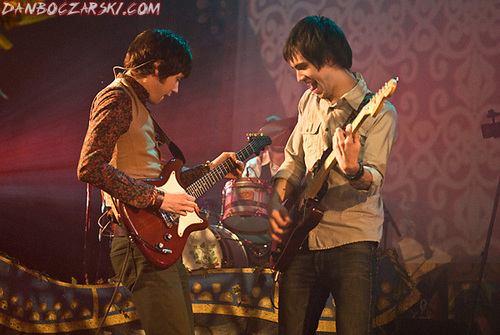
On July 6th 2009, Ryan Ross and Jon Walker left Panic! at the Disco, citing creative differences as the reason for their departure. A hiatus was announced on Twitter, and was left unmentioned by any band members until the release of the next album, Vices & Virtues.
Their fourth album, Vices & Virtues, was released March 22nd 2011, and was defined as Dance Punk and Alternative Rock.
Their fifth album, Too Weird To Live, Too Rare To Die!, was released October 8th 2013, and was defined as Synthpop and Electronica.
Line Up
Nominations & Awards
MTV Video Music Awards:
Nominated: Best Direction (2008) for "Nine in the Afternoon"
Nominated: Best Pop Video (2008) for "Nine in the Afternoon"
Won: Video of the Year (2006) for "I Write Sins Not Tragedies"
Nominated: Best Group Video (2006) for "I Write Sins Not Tragedies"
Nominated: Best Rock Video (2006) for "I Write Sins Not Tragedies"
Nominated: Best New Artist in a Video (2006) for "I Write Sins Not Tragedies"
Nominated: Best Art Direction in a Video (2006) for "I Write Sins Not Tragedies"
Los Premios MTV Latinoamérica:
Nominated: Best International Rock Group (2007)
Nominated: Best International Rock Group (2008)
MTV Asia Awards 2008:
Won: edc Style Award
TMF Awards:
Won: Best Video International (2006) for "I Write Sins Not Tragedies"
Grammy Awards:
Nominated: Best Boxed or Special Limited Edition Package (2008)
Nominated: Best Boxed or Special Limited Edition Package (2009)
Kerrang! Awards 2011:
Nominated: Best Single for "The Ballad of Mona Lisa"
Representation through Music Videos
Voyeurism - erotic pleasure can be gained by looking at a sexual object (preferably when the object is unaware of being watched).
This video is a parody of Robin Thicke's Blurred Lines, and is exactly the same as his except the role reversal; men are prancing around in underwear and heels around the female musicians for their pleasure. There is no backdrop to distract from the video, and you can see the female musicians check out the male models, making the female gaze even more obvious.
Homosexuality
This music video tells the story of a gay man's life from birth to death. It is purely narrative, and shows the stigma against the gay community. There is a cameo from the main artist in this video; the fact that his appearance is a cameo and also a candid shot shows that Macklemore doesn't care about being on camera, and this song is purely about gay rights activism, and this shown in the music video.
Strong Dominant Female
This music video is both performance and narrative. It features the band members individually dancing with male backing dancers on leashes. It portrays women as more powerful than men, which is shown by the synchronised dancing, props, low angle shots and the makeup, which is fairly dark, and makes them look menacing and dark. The music video works with the lyrics, as the lyrics are about female power and unity, with the lyric "Ladies, the time has come, the war has begun. Let us stand together. And remember, men fight great, but women are great fighters." This fits with the feminist issues that were public at the time of this song's release, and shows a sense of community amongst women.
Male Gaze- Laura Mulvey 1975 proposed that because filmmakers are predominantly male the presence of women is often for the purposes of display (rather than narrative). This is to facilitate a voyeuristic response in spectators, which presumes a male gaze (regardless of the gender of spectator) one that is or may feel like a powerful controlling gaze at the female on display who is effectively objectified and passive. In male performance videos the voyeuristic treatment of the female body is often apparent, with the use of dancers as adornments to the male star ego.
Exhibitionism - Female performers being at once sexually provocative and apparently in control of and inviting a sexualised gaze in what could be termed as the opposite of voyeurism.
More Uncommon Representation Stereotypes
Female GazeThis video is a parody of Robin Thicke's Blurred Lines, and is exactly the same as his except the role reversal; men are prancing around in underwear and heels around the female musicians for their pleasure. There is no backdrop to distract from the video, and you can see the female musicians check out the male models, making the female gaze even more obvious.
Homosexuality
This music video tells the story of a gay man's life from birth to death. It is purely narrative, and shows the stigma against the gay community. There is a cameo from the main artist in this video; the fact that his appearance is a cameo and also a candid shot shows that Macklemore doesn't care about being on camera, and this song is purely about gay rights activism, and this shown in the music video.
Strong Dominant Female
This music video is both performance and narrative. It features the band members individually dancing with male backing dancers on leashes. It portrays women as more powerful than men, which is shown by the synchronised dancing, props, low angle shots and the makeup, which is fairly dark, and makes them look menacing and dark. The music video works with the lyrics, as the lyrics are about female power and unity, with the lyric "Ladies, the time has come, the war has begun. Let us stand together. And remember, men fight great, but women are great fighters." This fits with the feminist issues that were public at the time of this song's release, and shows a sense of community amongst women.
How and Why Do We Consume Music?
How do you consume music?
When? Do you have a daily music routine? Is some music more suitable at a certain time of day than another? Where? clubs, bedroom, gigs, car?Every morning when I get ready, on bus journeys, car journeys, relaxing time, when I'm doing coursework at home and my evening routine all have different playlists which I use. I'm almost always listening to music and have playlists for all of these activities, as well as a variety of moods.
Who with? Do you share your music or is it an individual experience?
I mostly listen to music alone, however, my absolute favourites will be shared with everyone I see.
How? radio, computer, iPod, TV, live, dancing, homework, getting ready ie doing other things - background wallpaper
Through my iPod. Also, when I can, live, however it can be fairly expensive.
Why? What are the pleasures associated with music consumption? What does it offer the audience and what needs does it gratify?
Music can effect your mood by the melody or the lyrics. It creates an outlet or a form of escapism in which you can focus all of your energy into something other than what's immediately on your mind.
USES AND GRATIFICATIONS THEORY
When? Do you have a daily music routine? Is some music more suitable at a certain time of day than another? Where? clubs, bedroom, gigs, car?Every morning when I get ready, on bus journeys, car journeys, relaxing time, when I'm doing coursework at home and my evening routine all have different playlists which I use. I'm almost always listening to music and have playlists for all of these activities, as well as a variety of moods.
Who with? Do you share your music or is it an individual experience?
I mostly listen to music alone, however, my absolute favourites will be shared with everyone I see.
How? radio, computer, iPod, TV, live, dancing, homework, getting ready ie doing other things - background wallpaper
Through my iPod. Also, when I can, live, however it can be fairly expensive.
Why? What are the pleasures associated with music consumption? What does it offer the audience and what needs does it gratify?
Music can effect your mood by the melody or the lyrics. It creates an outlet or a form of escapism in which you can focus all of your energy into something other than what's immediately on your mind.
USES AND GRATIFICATIONS THEORY
Personal Identification - when I get angry with anything I blast songs that are quite angsty and angry. Genres include rock, metal, pop punk and some pop.
Information - sometimes you learn something from a song? A lot of my favourite songs are protest songs that teach you about the constrains of life through metaphor. An example is Blowin In The Wind by Bob Dylan.
Entertainment - some concept music videos, such as Here It Goes Again by Ok Go.
Social Interaction - songs my friends and I always request and dance to when we went out, such as Don't Stop by 5SOS and Girls by The 1975.
Music Video Concepts: No Rest - Dry the River
Lyrics:
What are the emotions it stirs?
The song is quite emotional, about the loss of a relationship that you put everything into. Quite heartfelt and very emotional.
What do you visualise? What images are conjured up in your mind when you hear the song? How do you picture the music video?
Starts with the lead vocalist sitting in the gutter, direct cut, so character is in the same place, to him in a throne. Vocalist stands and starts to walk through street/corridor in a palace, high street/courtyard or park/royal gardens. Tracking shots and 360 around Vocalist. Background actors and in greyscale, always the same, are labelled 'EX GIRLFRIEND', 'CHILDHOOD FRIEND', 'COLLEGE ROOMMATE', 'GRANDDAD' etc., always lipsyncing. At the end you see characters reach palace gates and stare wistfully into the other world, not seeing themselves there.
Intertextuality, voyeurism, performance, narrative, abstract? A combination?
Performance and Narrative.
What did others say about their ideas for a music video? Which did you like the best?
I liked the idea where the character walks through the street falling apart throughout the song until he's just a pile of ash at the end.
I used to be a king alone
Like Solomon or Rehoboam
And in the eaves, the Corvidae
Did jealous keep my picture frames
And everything did oxidate in place.
But then you came, a single cell
With astrolabe and carousel
And algebra and symmetry
And none of this was lost on me
And I could see how still I’d been before
If I don’t eat, I don’t sleep at all
Like limbs in procession,
Like so many birds
Stampeding like oxen,
Our hearts are a herd
I loved you in the best
I loved you in the best way possible
I loved you in the best
Did you see the light in my heart?
Did you see the sweat on my brow?
Did you see the fear in my heart?
Did you see me bleeding out?
I loved you in the best
I loved you in the best way possible
I loved you in the best way possible
I loved you in the best way possible
I loved you in the best…
Video:
Like Solomon or Rehoboam
And in the eaves, the Corvidae
Did jealous keep my picture frames
And everything did oxidate in place.
But then you came, a single cell
With astrolabe and carousel
And algebra and symmetry
And none of this was lost on me
And I could see how still I’d been before
If I don’t eat, I don’t sleep at all
Like limbs in procession,
Like so many birds
Stampeding like oxen,
Our hearts are a herd
I loved you in the best
I loved you in the best way possible
I loved you in the best
Did you see the light in my heart?
Did you see the sweat on my brow?
Did you see the fear in my heart?
Did you see me bleeding out?
I loved you in the best
I loved you in the best way possible
I loved you in the best way possible
I loved you in the best way possible
I loved you in the best…
Video:
What are the emotions it stirs?
The song is quite emotional, about the loss of a relationship that you put everything into. Quite heartfelt and very emotional.
What do you visualise? What images are conjured up in your mind when you hear the song? How do you picture the music video?
Starts with the lead vocalist sitting in the gutter, direct cut, so character is in the same place, to him in a throne. Vocalist stands and starts to walk through street/corridor in a palace, high street/courtyard or park/royal gardens. Tracking shots and 360 around Vocalist. Background actors and in greyscale, always the same, are labelled 'EX GIRLFRIEND', 'CHILDHOOD FRIEND', 'COLLEGE ROOMMATE', 'GRANDDAD' etc., always lipsyncing. At the end you see characters reach palace gates and stare wistfully into the other world, not seeing themselves there.
Intertextuality, voyeurism, performance, narrative, abstract? A combination?
Performance and Narrative.
What did others say about their ideas for a music video? Which did you like the best?
I liked the idea where the character walks through the street falling apart throughout the song until he's just a pile of ash at the end.

Katy Perry - Dark Horse
This pop music video uses a combination of narrative and performance. While the lyrics suggest a romantic nature to the song, the video content juxtaposes this, as it is mostly about Perry being a Pharaoh, with the male lead only debuting at the near end of the music video. This is a common fashion with Perry's videos, as they are often solely about her overcoming various obstacles and improving upon herself.
Panic! At The Disco - Girls/Girls/Boys
This music video is defined as a performance video; Brendon Urie stands directly before the camera and sings. There is no backdrop, so that nothing distracts from Urie. He is also naked in the video, which applies a female gaze to the video. The lyrics are about sexuality, which compliments the sexualised music video.
Emma Blackery - Go The Distance
This music video uses a combined performance and a narrative videotype, and has quite a slow image pace, contradicting the upbeat track. It also uses clips of live action, to give the video a slightly homemade feel. The narrative tells the story of a happy couple on a range of dates, ranging from a stay at home date to a trip around London. This amlifies the lyrics, as the song is quite happy-go-lucky and compliments the happy characters.
Andrew Goodwin's Music Video Theory
Conventions
1. Relationships between lyrics and visuals
2. Thought Beats - sound pace and visuals match
3. Genre relations and Iconography
4. Multiple Close Ups of artist/vocalist - Laura Mulvey's Male Gave
5. Voyeurism - especially towards females
6. Intertextual References
Elements Found in Music Videos
Voice within the song - uniqueness and recognition
Narrative to Performance - shows the music video to be an advert for the song
Star Image - iconography
Technical Aspects
Camera Movement
Camera Angles
Sound Pitch/Pace
Mise En Scene
Location, Outfits, Makeup
Editing
Image Pace
Ways to Promote a Song within a Music Video
1. Illustrate
2. Amplify
3. Disjuncture
Subscribe to:
Comments (Atom)